On Freedom
An autobiographical exploration of Virginia Woolf’s 1928 novel Orlando.
On the shorelines of Indonesia’s Lombok islands, after the sun sank into the sea’s horizon, after the air burst with the final call to prayer from the lone mosque, after the sunbathers had gone home from the beach and then gone home from dinner, too, I set out under the bright-faced stars to walk until I found myself where I began.
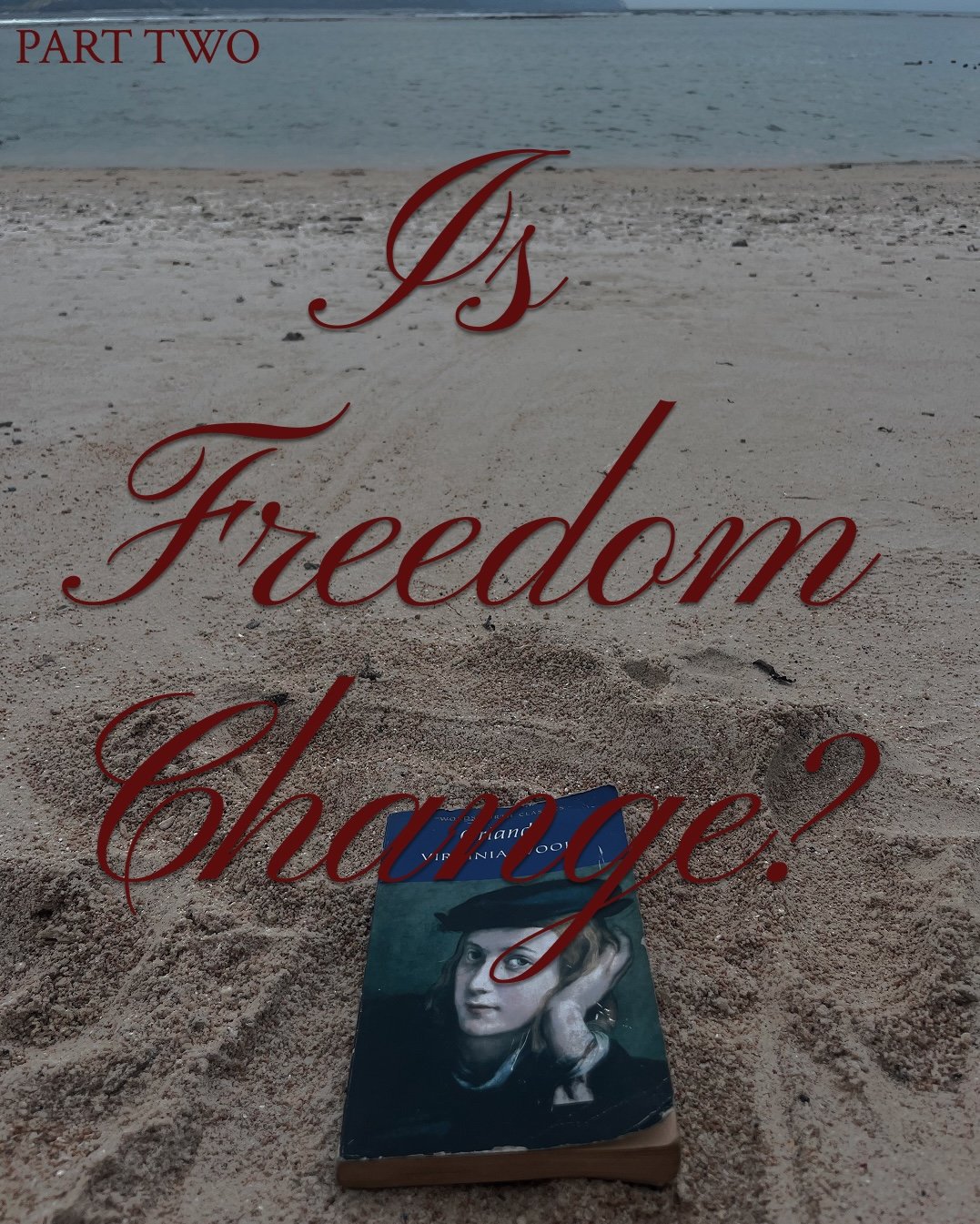
The circumference of the islands was small enough to cover in an hour or two, and I had Orlando on my mind. Novels, after all, affect us not just through the act of our reading, but in the atmosphere they leave us to reckon with, the sense of possibility that hovers with some imperative that, as Rilke wrote, You must change your life. And Orlando, this novel borne out as a love letter from Virginia Woolf to her lover, Vita Sackville-West, in which the main character is male until he is thirty, and then she is female—this novel especially stormed my senses for an urgent change. Perhaps it was because of the intense love the narrator feels for the character Orlando; for love from others, despite its ability to crystallize our virtues and level compassion for our flaws, still does not entirely free us. It may convince us for a time, and it may be the story we have been fantastically told since childhood, but ultimately freedom comes from within. We each have to free ourselves.
And, like me, Orlando is longing to be free. A fictional character based on the desires of the writer toward a real-life figure, Orlando is made as a beautiful boy, then a beautiful woman, changeable, playable, yet undeniably one defined soul. It is an interior novel, one that stays close to Orlando’s thoughts through his losses, her triumphs, and their evolutions immense enough to carry one character from the 1500s to the 1900s, from man to woman.
After my immersion in Orlando’s century-sweeping maturing, I was left with my own thoughts, as erratic and charged as Woolf’s sentences, but noticeably less loving. Because I didn’t feel all that happy, and certainly not free.
By all appearances, I should’ve been feeling more free on those Lombok islands than ever before. In the internal battles waged for freedom, comfort is often its enemy, and many times in the past, it was my comfort that won. But I was no longer in a relationship. I was no longer working a job for other people. I lived in multiple places, traveled often. I was on the other side of the world, on an island where I knew no one, where I walked freely, and yet even here, I didn’t feel free.
Had I missed the point? Was freedom from love, from work, from staying put and living somewhere, from social obligations, was that really freedom at all? Maybe these were simply conditions made for chronic loneliness. In truth, I was beginning to suspect that solitude was actually a repression, a protective turn away from the imperfections of others; a habit formed in adolescence which persisted.
As a boy, Orlando, too, “naturally loved solitary places, vast views, and to feel himself for ever and ever and ever alone.” One can imagine that for him, that aloneness was not easy to give up, and reserved only for those who stirred in him a desire to delicately open to their company, as well as a hope that they would not harm him.
Which might explain young Orlando’s response after Nick Greene, one of the finest poets of the Elizabethan era who Orlando had welcomed to his home and patronage, published a satirical pamphlet in which Orlando’s character and, alas, even his fledgling writing was mocked:
When he had read it, which he did with deadly composure from start to finish, he rang for the footman; delivered the document to him at the end of a pair of tongs; bade him drop it in the filthiest heart of the foulest midden on the estate. Then, when the man was turning to go he stopped him, “Take the swiftest horse in the stable,” he said, “ride for dear life to Harwich. There embark upon a ship which you will find bound for Norway. Buy for me from the King’s own kennels the finest elkhounds of the Royal strain, male and female. Bring them back without delay. For,” he murmured, scarcely above his breath as he turned to his books, “I have done with men.”
How many times had I murmured, in one way or another, while turning to my dog, my book, my newest island, that I had done with men? How many friends had I loved deeply, only to discover after countless hours together that competition or resentment marked the connection most? People I once dreamt with, maybe the highest form of intimacy, who now appear only in my dreams, a little shy, like last night’s apparition who I told, “I was just thinking of you. I am always thinking of you.” And yet, in the waking world, it is the same procedure: return to yourself, return to yourself, wish them the best and return to yourself, now more haunted, still you nonetheless.
Not just still you. More you.
I looked up and the stars laughed down at me, bright, icy laughs that echoed from where they each hung, alone in space, a chorus of loneliness. Your experience reveals yourself to yourself. Each person was sent to you for a purpose. If they don’t come back, that purpose was served.
Was it my heart or the words that burned like ice? Or was it the wind-drift of decades of ghosts, coming, going, coming back again?
Orlando, blessed and cursed with eternal life, was haunted for centuries. (Imagine, losing your first love in the Stuart era and then believing you see her again in a department store after the First World War.) And yet, each heartbreak propels them into a new stage of their life.
He discovers his first love, Sasha, in the lap of a sailor, and then, to make matters worse, she stands him up and returns to Russia. So Orlando hides himself away and devotes himself to his poetry. The poet Nick Greene disparages his friendship and writing. So Orlando leaves for Constantinople, where he serves as a diplomat for King Charles. After being promoted to duke, he narrowly survives a coup that throws the city into chaos. That’s when Orlando wakes up as a woman. She runs off with a group of nomads, but they fall out. She returns home to England. Due to her gender change, she’s greeted with lawsuits as her homecoming, and is at risk of losing her home, her everything.
And so on, tribulations begetting transformations, which beget more tribulations, until his heart has been broken and repaired so many times, you wonder at her resilience. You don’t wonder at how in the middle of each transition, Orlando sleeps for days or weeks, to the point where doctors are called in to check that they aren’t dead. Because as necessary as transformation might be, and as much as the stars may laugh at me for admitting it: It is exhausting.
And of course, sometimes it all becomes too much, and something to literally flee, as Orlando does, running through and falling into the precarious marshes drenched in metaphor, now a woman in the Victorian Era, unmarried in a coupled society, and someone who has given up, finally:
“I have sought happiness through many ages and not found it; fame and missed it; love and not known it; life—and behold, death is better. I have known many men and women,” she continued; “none have I understood. It is better that I should lie at peace here with only the sky above me…”
One might come to realize with a start, a cold shudder, that sometimes in our lives a death wish is merely a signal that a greater transformation is beckoning. In this case, it is the end of Orlando’s solitude. Her face in the marsh, her surrender complete, she hears the muffled thud of a heartbeat in the earth. It is in fact the horse hooves which carry the boyish sea captain Marmaduke Bonthrop Shelmerdine, and the recognition is instant, and mutual, both of these lovers not quite all man or all woman, both steering the ship of their own distinct destinies (her writing, his risky seafaring). And what can be more fearsome than being recognized, not just for sweeping likeness, its features eroded to soft edges, but one’s unlikeness, too? What can be more catastrophic? Woolf, of course, is one to acknowledge:
Change was incessant, and change perhaps would never cease. High battlements of thought, habits that had seemed as durable as stone, went down like shadows at the touch of another mind and left a naked sky and fresh stars twinkling in it.
The stars winked above me. Would I, too, look up one day at the touch of another, and see such nakedness? Would anyone rigid about something like gender be able to see all my selves, of which Woolf remarks “a person may have many thousand”?
Catastrophic, they said above. But catastrophe brings more life.
What are you still holding onto?
When I finished Orlando, I was left with the feeling of constraint, as if my own womanhood wrapped around me like the skirts I made out of the island shop’s modesty scarves. Hours after the book ended and, like all good books before it, returned from a passage to a mysterious universe back to a lifeless hunk of paper, finished in my hand, I discarded my skirts. I wore pants, smoked filterless kreteks, spoke as a man might to hustling locals, and set out for the first turn of many around the shoreline.
And yet, even that didn’t do. After some time, even masculinity became tiring, because I was still performing a part. The whole enterprise required too much thought, too much self-assessment. But what then did it mean, to be free in one’s gender?
I set forth once again with my memories and the stars to contend with. A familiar warm drift in the air greeted me, persisted even as the usual scenes came and went, tourists in bean bags up the slope of the shore, locals sleeping in wooden cabanas no longer rented after sundown, closed bar after closed bar where cheap booze was served by Muslims who themselves abstained. I walked until I forgot who I was, my shape as inconsequential as the waves rolling their miniscule backs against the sand, falling back into nothingness.
What did it mean to be a woman, anyway? It’s difficult to define without engaging the gender divide. For example, more often than not, I had heard men describe the women they came to know most (that is, previous lovers) in all their vulnerabilities, never their strengths. Beautiful but insecure, swept up by flattery, at risk to scream unreasonably in anger or jealousy. In the end, they were caricatures, symbols of vanity and incapability.
And yet as a woman myself, other women always seemed capable, almost to an exacting degree, and if they knew the cards were stacked against them, as they often were, some would hold fast to their integrity and longsuffering, while others would be so smart in their manoevers as to veer almost to the strategic thinking of war, and between those poles, a whole spectrum remained.
Orlando wakes in the body of a woman, but her mind takes more time to transition. She is surprised about the influence of clothing, remarking to herself: “Vain trifles as they seem, clothes have, they say, more important offices than merely to keep us warm. They change our view of the world and the world’s view of us.” She is surprised that a man topples overboard her ship back to England upon seeing her bare ankle. She is surprised that she cannot keep her title of Duke or the property that was formerly, as a man, her inheritance.
She is annoyed when, at a man’s unwanted and persistent advances, “she could no longer knock a man over the head or run him through the body with a rapier” (a sword). Instead, she must employ more subtle ways to dismiss his advances, including cheating him out of an enormous sum with a gambling game involving sugar lumps and flies (her deceit involved a dead one) and dropping a toad down the inside of his shirt. It’s an extreme example of the creative routes many women learn to have the freedom of choice in their lives. But not everything that leads to freedom is freedom itself.
In fact, traditional, stereotypical, caricatured womanhood brings to mind sweeping insecurity: we are taught that our most valuable offering is beauty, specifically beauty as accepted by society, which, in the eyes of society, has a very short shelf life; we are taught to compare our distinctive qualities with the incomparable other, that is, the incomparable other woman; we are taught not to believe other women and therefore disbelieve ourselves; we are taught to accept men we aren’t attracted to or who are much older due to what is often a guise of confidence and security. Looked at closely, normative womanhood was like a newly opened resort on these islands: grand and beautiful at first glance, colonized and cheapened upon further inspection.
It all makes you want to give up, doesn’t it? And yet as a woman, Orlando is free from the ingrained, gendered insecurities often formed in girlhood. Instead, she has the benefit of experiencing life both as man and woman. Even as her mind transitions to womanhood, she keeps her memories: she once was a womanizer through her boyhood, once wielded a sword in costume that suited free movement, once had the right to land and property and male titles. She didn’t have to physically be a man anymore to hold that multiplicity in her mind. Even as a woman, Orlando had the benefit of living both, being both. And yet, it was the multitudes of a woman in Virginia Woolf’s real life that inspired Orlando in the first place.
It’s an unfortunate yet common human phenomenon that we tend to experience great depths within ourselves, while our eye on others habitually oversimplifies. But too often is our own depth then in conflict with society as a whole, because we are strange, wrong, don’t fit in without playing pretend. Maybe this is the function of love: it is through the means of intense romance that the depths of another are met, courted, and venerated.
Because Virginia Woolf loved Vita Sackville-West, she could show profound affection for her multitudes in the shape of Orlando. And isn’t that one of the many faculties of fiction, to remind us through conceit what is possible in our reality? Such as when Woolf applies the fluidity of her protagonist to all human beings:
Different though the sexes are, they intermix. In every human being a vacillation from one sex to the other takes place, and often it is only the clothes that keep the male or female likeness, while underneath the sex is the very opposite of what it is above.
In other words, we all contain a vacillation between genders. But doesn’t this all go beyond gender? Don’t I, like Sackville-West, like everyone else in the world, have many thousand selves?
The stars blinked slow. You already knew that, they chided.
The trick is to stop hating all of who you are. Be your own lover.
How many years of my adolescence had I spent trying to form an identity, a self, that I might actually like to be? I thought that the self was something to construct, which is essentially an act of fleeing from the innate, the many. I thought I had to choose, and in choosing, had to brace myself against the incessant influx of parts I didn’t want, would never choose.
I stood on the shore, feeling simultaneously smaller and larger now under the stars. Suddenly, everything that kept me from freedom seemed to be a cause of self-hatred, or some-selves hatred.
Fallings out with friends haunted my dreams, but not because all humans are doomed to live with such ghosts. It’s because they had seen one or another aspect of my selves and found them worthy of rejection. Unfortunately I had, on some level, agreed.
The negative reputation of my gender weighed on me because I feigned that I, or anyone, fully belonged to it. It was little more in definition than a body type used for projection by the small minded. But somehow I had picked up these narrow expectations and degradations, as if they belonged to me.
With every wave came another scene, rapidly expanding on the shore. Cresting here I watched my cousin learn the pirouette from behind glass, dreaming of becoming a ballet dancer with a swan’s neck and a tutu. Cresting there I tucked my hair into a cap as I schemed to crash an all-boys camping trip. Cresting here I felt a pang of jealousy, but pretended to laugh it off. Cresting here I said sorrywhen I should have said oh, fuck off. Cresting here I tried to convince others I was good, only good.
Cresting here. Confident and outspoken. Cresting here. Light and sardonic. Cresting. Miserable and despondent. Angry and embittered. Playful and irreverent. Diplomatic and gracious. Very, very young. Quite old. And everything between…
How they express across the landscape of my life is my choice, not that of my gender or societal standing. And even then, I was not limited to two or three. I could inhabit any number, discard them at will, return to them when it suited me or abandon them forever. Like friends and foes, my selves could come and go, and it was nothing to cling to, little to mourn. An appreciation for it all, the pleasure and the pain of being and being in the crowded company of myself, of others, drowned me in its waves.
After a time, I looked up. These thoughts had silenced the stars, returned now, for the moment, from sentient beings back to bright gases slowly exploding.
My feet were on the ground. I was left to my human work. Somewhere on another continent, the stranger who would become my Shelmerdine was asleep in the late afternoon sun, a sailor cap crooked on his head. But already my sky was naked. There was room, all at once, for freedom to come rushing in. And a blank page, too, is freedom: that space made for our momentary selves to remain, long after they’re gone.